
Bridgeton Historical Directory Holdings
For Bridgeton, the verified starting point is the New Jersey State Library city-directory catalog. It separates county-wide Cumberland books from Bridgeton-specific books and records useful shelf or reel clues. That distinction matters. The earliest books can name people in the wider county, while later volumes focus more tightly on Bridgeton. Catalog abbreviations and reel numbers are access aids, not proof that every volume is online or that every year was printed.
| Collection | Years | Where Held | Access |
|---|---|---|---|
| Boyd's Cumberland County Directory | 1881–82 | New Jersey State Library catalog | County-wide volume, including Bridgeton |
| Boyd / C. E. Howe Cumberland and Salem/Cumberland directories | 1883–84, 1887–88 through 1905–06 | New Jersey State Library catalog | County-wide Bridgeton comparison runs |
| Warren's Cumberland County Directory | 1909–10 | New Jersey State Library catalog | County-wide Bridgeton baseline |
| Directory of Bridgeton, Bridgeton Directory Company | 1921–22 | State Library, Segment IV Reel 24 | Bridgeton-specific catalog entry |
| Polk's Bridgeton City Directory | 1924–30; selected 1964–86 years | State Library books and cataloged reels | Verify each listed volume before travel |
There is no uninterrupted Bridgeton series. The Bridgeton catalog identifies selected Polk years, including 1964, 1966, 1969, 1973, 1975, 1977, 1979, 1980, 1981 and 1986. A person absent from one year may have moved, but the safer conclusion is first that no matching volume may exist.
Bridgeton County Directory Beginnings
County books provide the first printed directory layer for Bridgeton research. Boyd's 1881–82 volume is the early baseline for a Bridgeton surname. The catalog then lists Boyd or C. E. Howe Cumberland and Salem/Cumberland issues at intervals through 1905–06, followed by Warren's 1909–10 Cumberland County Directory. Their county scope is important: a Bridgeton address or business may appear, but the books do not operate as a city-only list.
Use the county run to preserve a surname spelling, occupation, business reference, or address before jumping to the later Bridgeton books. It can also reveal that a family moved within Cumberland County rather than left the region. For much older Bridgeton legal or land research, the State Archives Cumberland deed guide identifies deeds from 1785–1901 and indexes through 1952, a different record layer from a printed directory.
Note: County-wide coverage is valuable context, but it does not make every Cumberland household a Bridgeton resident.
Bridgeton Directory Publisher Runs
The 1921–22 Directory of Bridgeton is the first verified Bridgeton-specific catalog entry and is tied to Segment IV Reel 24. Polk then appears for 1924–25, 1926–27, 1928–29 and 1930. The catalog resumes with selected later Polk volumes rather than a continuous annual sequence. The 1975, 1977, 1979 and 1980 titles include a rural-route directory; 1981 and 1986 also include Upper Deerfield Township. Those regional additions require careful reading of the actual city entry for Bridgeton research.
A catalog entry for Polk's Camden County listing in 1937–38 is not evidence of a Bridgeton book or a Bridgeton address source. The catalog itself points to a Camden County Historical Society reel, so confirm its title and shelf before relying on it. This small caution prevents a plausible-looking date from becoming an unsupported household finding.
- 1881–82: Boyd's Cumberland County Directory supplies the earliest verified Bridgeton printed run.
- 1883–1906: Boyd and Howe county volumes give intermittent Bridgeton comparison points.
- 1909–10: Warren's county directory precedes the Bridgeton-specific series.
- 1921–22: Bridgeton Directory Company appears in the catalog as a Bridgeton volume.
- 1924–30 and selected 1964–86 years: Polk provides later Bridgeton city snapshots with documented gaps.
That timeline reflects cataloged coverage, not a promise of a named person in every book.
How Bridgeton Directory Entries Read
A Bridgeton city directory page image was not captured for this research, so its abbreviations should be read from the Bridgeton volume's own key. Still, the catalog and local research example support a practical inventory of fields to look for. Copy the printing exactly, including initials and relationship notation. A directory entry is a historical publisher's description, not a current record and not proof that every person in a home was listed.
| Name | Surname and given name or initials, often the starting point for the Bridgeton alphabetic section. |
|---|---|
| Relationship notation | A spouse, widow, or family relationship may appear in parentheses in a Bridgeton household entry where the publisher used it. |
| Occupation or business | An occupation, business connection, or Bridgeton business address can distinguish people with the same name. |
| Street address | A house number and Bridgeton street, sometimes paired with a business address or later telephone number. |
| Owner or renter mark | A publisher convention to verify in that volume, never a present-day conclusion. |
- Criss-cross directory
- An address-ordered section that can be used to look from a Bridgeton street number back to an entry, if that volume includes one.
- Householder index
- An alphabetic or household-oriented index that helps connect a name to the fuller Bridgeton listing.
- Abbreviation key
- The publisher's explanation of marks and shortened words, usually near the front of a Bridgeton volume. Photograph or copy it before interpreting entries.
Note: Preserve an unclear mark as printed and ask the Bridgeton holding library to check the volume's abbreviation key.
Bridgeton Local-History Directory Leads
Bridgeton Free Public Library is a local reference route, even though a current public city-directory shelf list was not located. The State Library's archival collection catalog for BFPL describes a small collection with no detailed index. It includes Enoch Fithian genealogy from 1640 into the mid-1800s, four Elizabeth Lockwood Coombes local-history volumes, George J. Woodruff papers from 1911–60, and organization records with documented gaps.
The official Bridgeton Free Public Library page is the source for this local-history contact view.
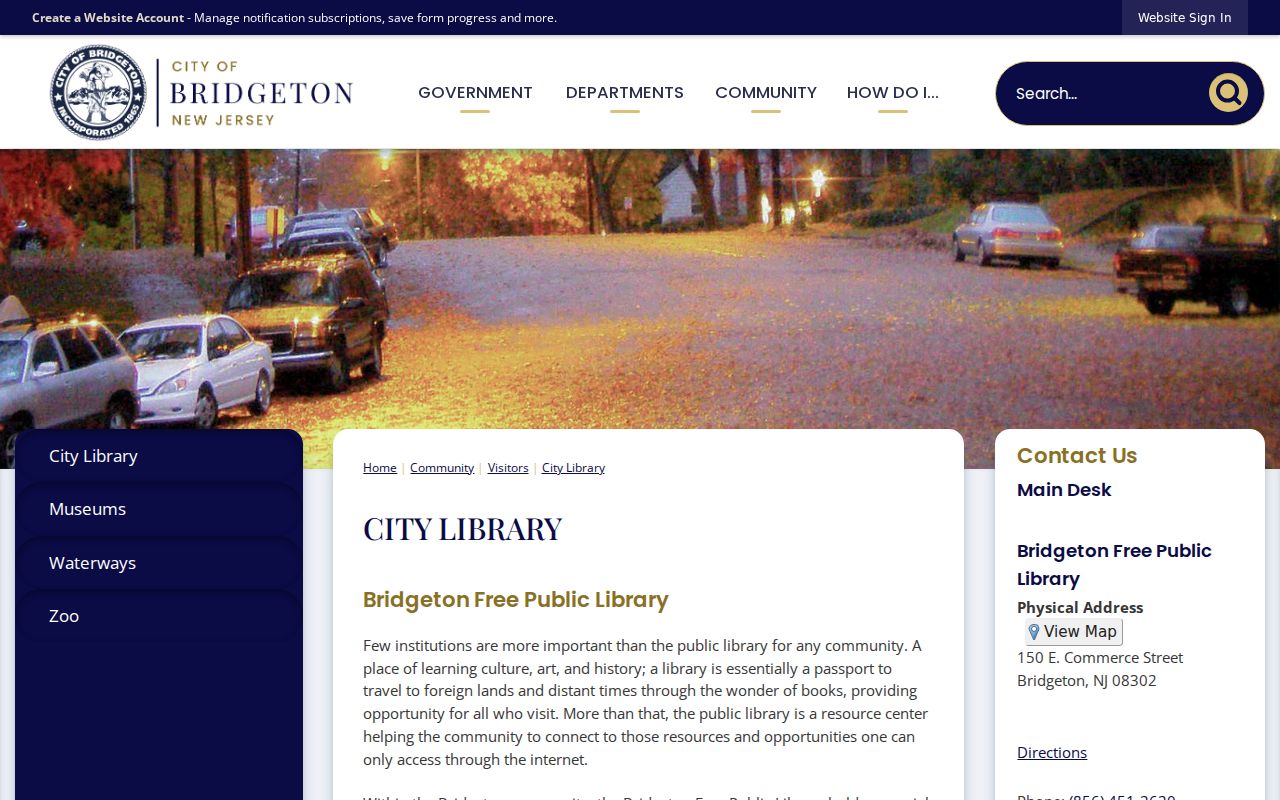
The Bridgeton library route is most useful when a directory name needs local context. Ask whether a named box, organization series, newspaper reel, obituary index, yearbook, or directory is currently available rather than assuming an online index exists.
The collection includes examples such as Bicycle Club records from 1885–89, Book Club material from 1893–1901, Lyceum records from 1840–1941, Musical Union papers from 1880–1917, and YMCA Women's Auxiliary records from 1886–1901. A brief box review can add Bridgeton organization history or a relationship connection that a printed directory cannot show.
CCHS Bridgeton Directory Example
The Cumberland County Historical Society's “Mystery of the Buried Box” shows the local method in practice. Its research cites Bridgeton directories for 1921–22, 1928–29, 1930–31, 1937–38, 1940, 1945, 1947, 1949, 1950–51 and 1953. The article uses directory evidence to put a person at a Bridgeton address, connect an occupation or business, and move a Bridgeton family-history question forward across several years.
CCHS is a Bridgeton research contact, not a guaranteed public online directory index. The society lists P.O. Box 16, Greenwich, NJ 08323 and 856-455-8580. Current appointment, index, fee, and member-access rules were not located in the official sources, so call before travel. This preserves the valuable example without inventing a shelf or scan that may not be available.
Bridgeton Directory Timeline
Bridgeton's directory history sits between much older county books and modern record systems. Cumberland County chose Cohansey Bridge, later associated with Bridgeton, as its county seat in December 1748 and built its first courthouse in 1752. The County Clerk's Record Vault describes land records from 1748, while the printed directory trail begins more than a century later. That long timeline helps explain why an early Bridgeton address question may require deeds or archives before it reaches a printed directory.
Printed county directories start in 1881–82. Bridgeton-specific coverage begins in 1921–22, then selected Polk volumes carry the visible record into 1986. The New Jersey State Archives genealogy collections add census, vital-index, county-record, and archival routes when a directory gap blocks the next step. Federal census releases are decennial snapshots, so they should not be treated as a substitute for a missing annual volume.
Note: A gap in the Bridgeton directory sequence is a collection fact, not evidence that a household vanished.
Tracing Bridgeton Directory Households
Use the Bridgeton volumes as a sequence of dated observations. Begin at the exact street address in the 1921–22 or 1924–25 run when those dates fit the question. Copy the name spelling, initials, spouse or widow notation, occupation, and address. Then move one available volume earlier and later. Search both the alphabetic name section and the street section if the book has one. A business address deserves its own search because it may not match the household address.
- Start with the nearest verified volume and transcribe the entry without expanding abbreviations from memory.
- Check adjacent available directory years, noting each address, business reference, and spelling change.
- Use any criss-cross or street section to test the address and nearby numbered entries.
- Pair a directory year with the appropriate federal or New Jersey census year, keeping the different dates separate.
- Use a deed, obituary, or probate record to investigate a move, death, estate, or ownership transition.
A disappearance can reflect a move, death, non-listing, a changed spelling, or simply no surviving cataloged volume. For a current parcel or a modern address record, use the Bridgeton Street Directory rather than trying to extend a historic printed entry into the present.
Bridgeton Directory Addresses on Maps
The Library of Congress Bridgeton Sanborn record is an October 1923 set of 33 sheets. It can place a city-directory address in a block, building, business, church, factory, or street context. It cannot identify residents. Pair a sheet with the 1921–22 or 1924–25 directory rather than asking the map to provide a name it does not contain.
Bridgeton's historic district includes approximately 2,200 residential, commercial, industrial, and ecclesiastic structures and received its State Register listing in February 1982 and National Register listing in October 1982. That scale makes map context especially useful when an address changed use. It also reinforces a basic rule: a directory address is a dated observation, and the building at that location may have a different story in another year.